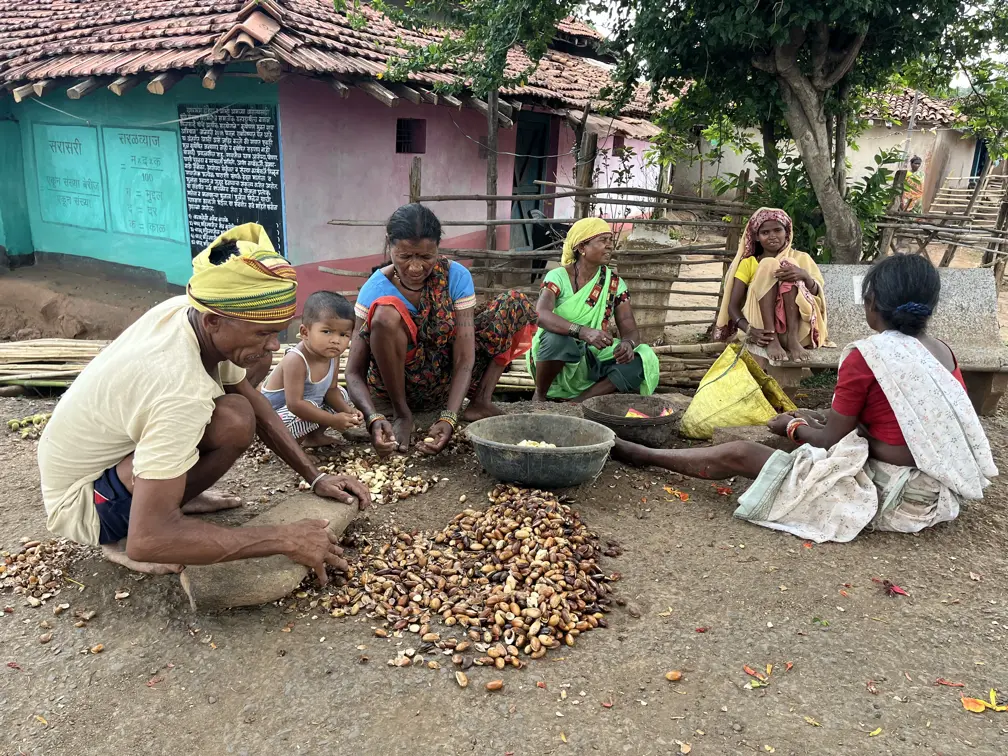
Gadchiroli, Maharashtra: A blanket of long, oval seeds of mahua (Terminalia chebula) in varying shades of brown greets visitors as they enter Zendepar village in Maharashtra’s Gadchiroli district. Women, dressed in bright colours, sit in some chatter, peeling seeds. The seeds will be crushed to extract oil. Oil from the Mahua seed - collected from the forests that flank Zendepar - is a large source of income for the Gond tribal community that reside here.
However, things looked different just 15 years ago. This community, inextricably connected to the forests, was kept away by law.
“Collection of forest produce was not allowed. The land belonged to the forest department,” said Samaru Kallo, a farmer in Zendepar. Despite the ban, most households ventured into the forests to collect firewood that lit up their stoves. “We would have to pay a bribe if the guard caught us. If we didn’t have money to give, we’d have to give chickens or rice,” he said.
What changed for the community was obtaining the Community Forest Rights (CFR) title under the Forest Rights Act in 2011. The title grants forest-dwelling communities the authority to own, manage, and conserve their forest resources. “After getting our forest rights, we feel like the owners of the forest,” said Kallo.
Villagers were no longer trespassers, but custodians of the forest. And now, as custodians, they’ve pioneered a management plan that taps into their ancient reverence for their forests. This includes, prohibiting hunting of animals, distribution of grazing passes inspired by their traditional practice of rotational grazing, planting of medicinal herbs and bamboo, and conservation of water. Culturally, the Gond tribal community have ensured the management plans champions the role of women as the custodians of their commons.
Communities create commons
Zendepar’s forests are among the 205 million acres of common lands, which includes community-shared lands such as forests, pastures, water bodies and mangroves in India. Over 350 million persons, including marginalised groups like Scheduled Castes, Scheduled Tribes and women, depend on these lands that cover nearly a fourth of India’s landscape.
Communities across India have traditionally protected, restored and managed these commons through customary self-governance practices. These customary rights and practices, however, haven’t been formally recognised in many parts of the country.
The protection of commons has continued despite contesting demands over resources, lack of formal aid or policy recognition, environmental degradation and climate vulnerabilities.
Like the Gond tribals of Zendepar, communities are showcasing that reclaiming, restoring and managing commons through customary self-governance practices can play a crucial role in their ecological, social and economic upliftment. This story is part of a series by Land Conflict Watch, a Delhi-based research group, in collaboration with Common Ground Initiative, a collaborative working on the commons, to document such case studies of successful collective action of communities around common from across the country.
Tapping traditional knowledge in the management plan
A few years after having won their rights over forests, Zendepar sought to channelise their informal, traditional knowledge into a formal, management plan.
In 2017, Maharashtra’s tribal department sanctioned funds to support forest management plans jointly developed by the gram sabhas, Non-Governmental Organisations (NGOs), and educational institutions. The NGO chosen to help Zendepar was Amhi Amchya Arogyasathi (AAA) that is based out of Nagpur and works on rural empowerment particularly in tribal areas. “We held residential training in Korchi (the taluk headquarters) in 2022 and 2023. Participants from each village were taught how to make plans. Each plan takes about 8-10 months to prepare,” said Padma Uikey from AAA.
In Zendepar, the Gond tribal community brought in elements of their tradition to the forest management plan: prohibiting hunting of animals, many of which are worshiped by the tribal community; distribution of grazing passes inspired by their traditional practice of rotational grazing (giving villagers and their livestock designated spaces to avoid overgrazing and allowing grass to recover); and their knowledge of agroforestry where medicinal herbs and other dwindled plant species are being regrown within the forests.
The management plan envisions construction, maintenance, and repair of ponds, reservoirs, check dams, and embankments across the village. This, say villagers, will help in moisture retention and water conservation and irrigation.
These management plans are to be approved by the District Collector and a district-level convergence committee after which funds will be sanctioned to the Gram Sabha.
But, at Zendepar, villagers proactively started work, hoping to start the preservation of their forests before the slow wheels of bureaucracy could complete the approvals process.
“We created a phal baag (orchards). We have planted jamuns for our consumption as well as to sell in the markets,” said 39-year-old Chandra Kala, who took part in the creation of the management plan. “We have also planted bamboo as its shoots can be used as food,” she said.
Villagers have taken this up despite the shortage of water and frequent crop damage due to monkeys. “We hope that once the management plan is approved, we can build a pond that will make water easily available for plantations,” said Chandra Kala.
Championing the role of women
It’s not just protection of nature that has translated itself in the plan. A core ideal of the Gond system of belief is equality of men and women. “It is compulsory for at least one woman and one male voter from each family over the age of 18 to be present at the Gram Sabha meeting,” says the management plan.
The plan goes into specific details of how to hold meetings so that it becomes a safe, enabling space for women: including, holding meetings at an earlier time to be mindful of the schedules of women as well as safe locations to hold audits so that women feel safe.
The plan recognises and reflects the critical role played by women in the village and forest economy. At the core of this is the women-run Self-Help Groups (SHGs), community-based organisations where members pool resources. While SHGs in the village started off as giving low-interest loans to its members; by 2023, they had evolved to establish a formalised structure for gathering, marketing and selling forest resources.
Each day, the community heads into the forest to collect a variety of forest produce, including: mahua, hirda (Terminalia chebula – a medicinal fruit), charoli (Buchanania lanzan - wild edible plant), bael (wood apple - herbal fruit), baheda (Terminalia bellirica – herbal medicine).
“Each part of the forest is useful to us. Fruits like Jamun can earn us ₹1,200 during its season. Medicinal plants are abundant here. Even wood collected from the forest is used in making windows or burned during the Holi festival. The mahua leaves are used in sacred occasions like weddings,” said Antaro Bai Madavi. On this balmy day, she had spent the morning in the forests collecting mahua seeds. When they’ve gathered enough, the women would use rudimentary machines to extract oil from the seeds.
All profits are shared among SHG members.
The profits can be significant for a family, with a family earning up to ₹30,000 per year. A family of four can earn upwards of ₹18,000 in just a week through sale of tendu leaves. These leaves are used to make bidis, a type of Indian cigarette. In a 20-day season, Mahua can earn a family ₹4,000.
Creating documents to prepare against climate change
This knowledge - of the species of plants available in the forest and their uses - has been tabulated in a biodiversity registry. The registry also keeps an account of the forest produce collected by each family, its use or sale value, and the time period of collection. This information has become critical in determining the focus areas of the management plan: helping them prioritise regeneration of plants whose collections have been declining in quantity.
The management plan also considers the impact of climate change on their forests. This includes tracking fauna whose availability is declining due to increasingly scalding summers. “Taking into account the adverse effects of climate change, all villagers will adopt organic farming…use of pesticide and weedicide chemicals will be reduced…The community will adopt biological methods of pest control,” states the management plan.
A forest under threat
The management plan comes at a time when their hard-earned right to manage their forests is under threat. A cluster of 5 iron-ore mines is proposed on 61.52 hectares of forests in the region.
Though the mines are coming up on lands that the government considers “wastelands” (that is, it is categorised as such in revenue records), for villagers, it is an integral part of their sacred forest eco-system. The mines will be surrounded by lands where villagers have their CFR titles. The promise encapsulated in their management plans threatens to unfurl.
“We’ve defied authorities and held protests. These mines will take away our forest,” said Amita Madavi, a mother of two and an active member of the SHG. The site is home to mahua, sangwan (teak) trees.